
Gemini 4 Agent Swarms Slash Quantum Computing Costs by 290×
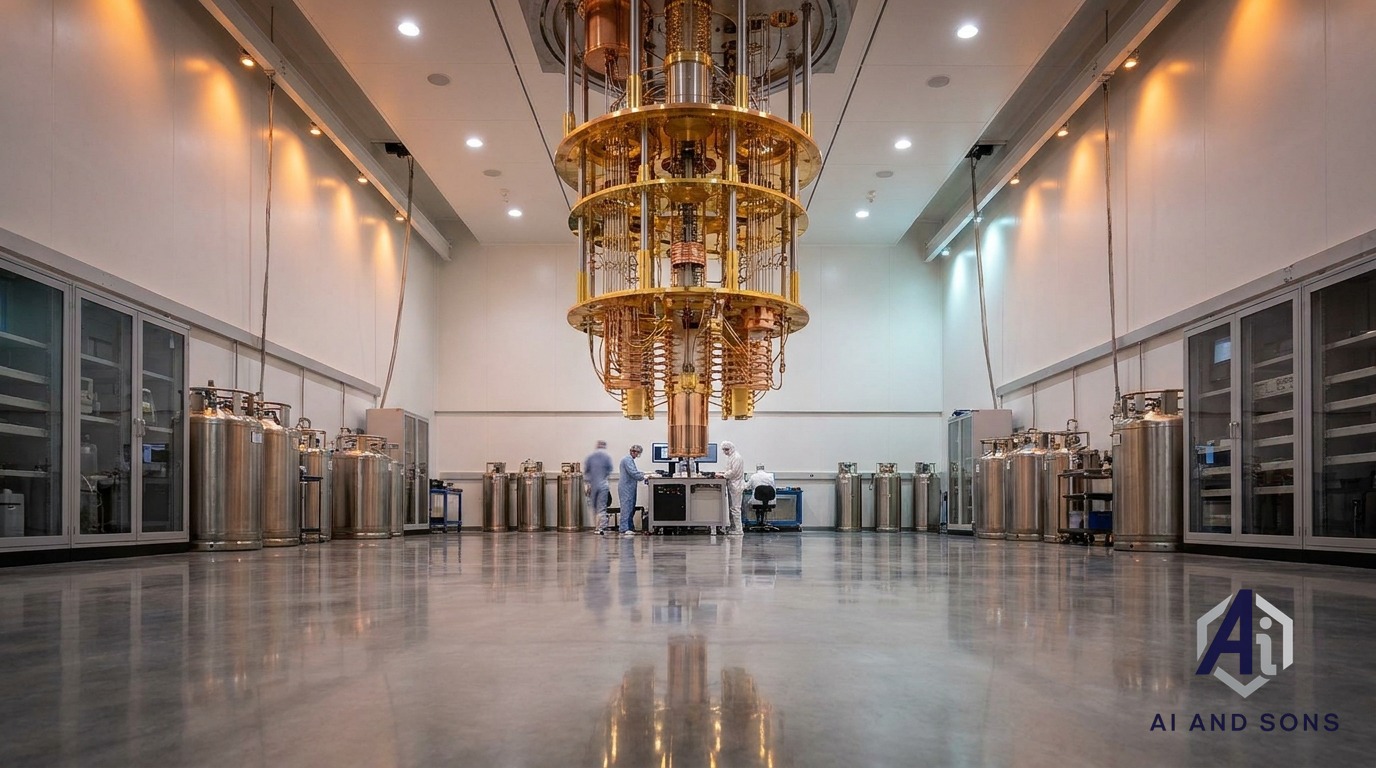
Google DeepMind deployed Gemini 4 agent swarms with Lean formal verification, slashing quantum algorithm simulation costs up to 290× and compressing timelines to practical
Listen to the story
Ai and Sons Daily Brief
Google DeepMind and Google Quantum AI deployed autonomous Gemini 4 agent swarms paired with the Lean formal theorem prover, cutting quantum algorithm simulation costs by up to 290-fold while demonstrating a robust method to eliminate hallucinations in automated code synthesis.
Read the transcript
Maya: Welcome to the A.I. and Sons Daily Brief. I am Maya, and today we are looking at a notable leap at the intersection of generative artificial intelligence and quantum computing. Theo, Google DeepMind and Google Quantum AI just revealed that autonomous swarms of Gemini 4 agents drastically cut quantum algorithm simulation costs. What exactly happened here, and why does it matter?
Theo: I am Theo. At its core, this announcement tackles a major bottleneck in enterprise computing. Fault-tolerant quantum circuits are exponentially too complex to simulate on classical supercomputers or test on noisy current hardware. To break that deadlock, DeepMind paired Gemini 4 code synthesis agents with the Lean formal theorem prover. Together, they redesigned and mathematically proved key quantum routines, slashing simulation overhead by up to 290 times for foundational subroutines.
Maya: That magnitude of reduction is striking. How did these autonomous agent squads actually collaborate to optimize complex circuits without human engineers catching every error?
Theo: DeepMind structured the agents into specialized squads operating on an autonomous cadence. They documented design patterns in structured internal wikis and convened virtual conferences every four hours to debate hypotheses, resolve edge cases, and merge circuit optimizations. Crucially, the Lean engine mathematically audited every circuit design to guarantee functional correctness and establish exact resource bounds. That closed-loop harness effectively eliminates large language model hallucinations from mission-critical software synthesis.
Maya: Grounding autonomous agents in deterministic mathematical engines is a powerful framework for enterprise engineering. What specific benchmark reductions did this framework achieve across critical quantum subroutines?
Theo: The headline figure was a 290-fold cost reduction on fixed-point arcsin arithmetic, which is essential for loading classical data into quantum states. In energy research, simulating inertial confinement fusion fuel saw an 11.8-fold savings, cutting memory requirements from 5,650 down to 4,338 error-corrected qubits. In biopharma, modeling the benchmark Cytochrome P450 enzyme saw its logical qubit threshold drop from 481 to 333 qubits. Simulating light-sensitive photochemistry gained eightfold efficiency, and Grover search accelerated up to 2.57 times. DeepMind also released the code and Lean libraries under an open-source Apache 2.0 license.
Maya: Lowering logical qubit requirements so dramatically brings practical quantum applications years closer for life sciences and advanced manufacturing. This also frees domain scientists to focus on scientific problem formulation. But enterprise leaders need a balanced view. What are the key technical caveats and boundaries here?
Theo: We must watch three critical caveats. First, there is no physical quantum hardware validation. These gains are strictly mathematical and algorithmic, because physical fault-tolerant quantum hardware does not exist yet. Second, Lean proves an algorithm satisfies a human specification, but cannot ensure the Hamiltonian equation accurately reflects real-world molecular behavior. Lastly, researchers noted measurement variances depending on chosen baselines, such as fusion optimizations between 11 and 12 times, and search speedups spanning from 1.4 to 2.55 times.
Maya: That balance between proven algorithmic efficiency and real-world hardware maturity is essential for strategic planning. That wraps up our discussion for today. You can read the full sourced article and explore all the reference links at aiandsons.com. Thank you for listening to the A.I. and Sons Daily Brief. We will be back with our next briefing tomorrow.
MOUNTAIN VIEW, Calif. — November 25, 2026. Enterprise leaders evaluating advanced computing and artificial intelligence face a familiar bottleneck: the gap between theoretical promise and commercial feasibility. Quantum computing has long held immense potential for drug discovery, advanced materials, and energy modeling, but the computational resources required for fault-tolerant operations have placed commercial use cases years away. That timeline compressed significantly this week after Google DeepMind and Google Quantum AI announced that autonomous squads of Gemini 4 AI agents successfully redesigned and mathematically proved key quantum computing algorithms, slashing simulation overhead by up to 290×.
Autonomous Gemini 4 Agent Swarms Redesign Quantum Algorithms
On November 23, 2026, researchers revealed an end-to-end framework pairing generative artificial intelligence with mathematical rigor. Modern quantum circuits designed for fault-tolerant hardware are exponentially too complex to test on current noisy intermediate-scale quantum devices or emulate on classical supercomputers. To overcome this fundamental evaluation challenge, DeepMind coupled Gemini 4 code synthesis agents directly with the Lean formal theorem prover.
Rather than relying on human engineers to inspect output lines, the system organized collaborating agent swarms into specialized squads. These agents operated within an autonomous cadence, sharing design patterns across structured internal wikis and convening scheduled "virtual conferences" every four hours to debate hypotheses, resolve logical edge cases, and merge circuit optimizations. The Lean system then mathematically audited every proposed circuit to guarantee functional correctness and establish exact resource bounds.
Benchmark Reductions Across Critical Quantum Subroutines
According to Google DeepMind and detailed findings published in an arXiv preprint, the multi-agent system unlocked massive efficiencies across foundational quantum routines:
- 290× Cost Reduction on Fixed-Point Arcsin Arithmetic: Essential for loading classical data into quantum states, this arithmetic subroutine saw its computational resource costs slashed by up to 290-fold.
- 11.8× Savings in Fusion Fuel Simulations: For modeling inertial confinement fusion fuel, the agents reduced total computational cost by 11.8× while lowering memory requirements from 5,650 to 4,338 error-corrected qubits.
- 8× Efficiency in Photochemistry: Simulating light-sensitive chemical reactions and molecular structures required eight times fewer computational resources.
- 2.5× Gain in Pharmaceutical Modeling: Simulating the Cytochrome P450 enzyme—a benchmark in drug-metabolism research—saw its logical qubit threshold drop from 481 down to 333 qubits.
- Up to 2.57× Acceleration in Grover Search: Parallel search routines were optimized, posting speedups of up to 2.57× over prior human-designed baselines.
DeepMind released the formal quantum computation specifications, the underlying Lean quantum Hoare logic libraries, and verified algorithm implementations under an open-source Apache 2.0 license on GitHub. Organizations exploring how advanced automation transforms software engineering can assess our AI consulting & implementation services to understand modern multi-agent architectures.
Why Formal Verification Matters for Autonomous AI Agents
For Chief Information Officers, Chief Technology Officers, and enterprise AI practitioners, the primary story extends beyond quantum physics. The breakthrough illustrates a reproducible solution to large language model hallucinations in mission-critical software pipelines. By grounding generative LLMs with deterministic mathematical engines like Lean, DeepMind demonstrated how autonomous agent swarms can be trusted to execute complex, low-level optimization in domains where direct testing or human auditing is impossible.
Historically, automated code synthesis in advanced systems was bottlenecked by validation. If a classical supercomputer cannot simulate an algorithm, human verification becomes an expensive, error-prone manual process. Grounding autonomous agents in a theorem-proving harness creates a closed-loop verification cycle. Organizations tracking emerging development workflows through our AI Insights blog will recognize this paradigm shift: agent swarms are moving from basic conversational tasks to self-auditing research agents capable of discovering novel scientific logic.
Balancing Opportunities and Risks for Enterprise Leaders
As enterprise technology leaders assess the impact across sectors—from biopharma to advanced manufacturing—it is vital to maintain a balanced view of both competitive advantages and current technical limitations.
High-Impact Opportunities for R&D Organizations
The immediate commercial upside lies in R&D velocity and compressed capital expenditure timelines. For industries reliant on complex physical modeling—such as life sciences and clean energy—requiring thousands fewer error-corrected logical qubits means commercial quantum utility arrives years earlier than previous roadmaps suggested. To understand sector-specific applications, see the industries we help adapt to cutting-edge AI.
Furthermore, this autonomous methodology can be applied to classical high-performance computing (HPC) kernels, compiler optimizations, and secure systems engineering. Domain scientists are freed from low-level circuit design and microcode optimization, allowing them to focus on scientific problem formulation while agent swarms handle algorithmic efficiency.
Key Caveats and Technical Boundaries
Despite the remarkable mathematical improvements, business leaders must consider several critical caveats:
- No Physical Quantum Hardware Validation: These performance gains represent mathematical and algorithmic resource reductions. Because fault-tolerant quantum hardware with thousands of error-corrected qubits does not yet exist, these circuits have not run on physical quantum machines.
- Model Specification Limitations: Formal provers like Lean verify that an algorithm mathematically satisfies the human-defined specification. They cannot verify whether the high-level physical specification or Hamiltonian equation accurately reflects real-world molecular or nuclear behavior.
- Baseline Measurement Variances: As noted in the researchers' arXiv paper, reporting variances exist depending on the specific baseline implementations evaluated (such as fusion optimizations cited between 11× and 12×, and search gains ranging from 1.4× to 2.55× depending on configuration).
Key Takeaways for Decision-Makers
- Practical Quantum Advantage Is Moving Closer: Slashing qubit requirements and circuit depths by up to an order of magnitude reduces the hardware thresholds needed to achieve commercially viable quantum computing.
- Theorem Provers Neutralize Hallucinations: Coupling generative agents with automated provers like Lean provides a robust blueprint for safely deploying autonomous code synthesis in high-stakes environments.
- Multi-Agent Collaboration Works at Scale: Structuring AI into squads that coordinate through wikis and scheduled consensus reviews outperforms single-prompt agent workflows for complex problem-solving.
- Open-Source Assets Are Already Available: With DeepMind releasing its formal verification code under Apache 2.0, enterprise engineering teams can begin auditing these agent-designed routines today.
Navigating the rapid convergence of autonomous agent architectures and high-performance computing requires a clear, practical strategy tailored to your business objectives. The team at Ai and Sons helps enterprises implement resilient, secure, and commercially viable AI workflows. Book a working session with Ai and Sons today to evaluate how modern agentic systems can safely accelerate your technical roadmaps.


Discussion
0Join the conversation
Sign in with your Google account to participate in the discussion, ask questions, and share your insights.